

A Curated Guide to Japanese Tableware
Last updated: 30 August 2026
More than just vessels for food, Japanese tableware invites you to experience beauty in daily life. This guide explains the names, sizes, materials and regional styles behind each piece, and shows you how to find what you are looking for in our Japanese Tableware collection.
Our specialist, Kai, wrote this guide to Japanese tableware. In this guide:
- Names and types — what each piece is called and what it holds.
- The philosophy — why a Japanese table uses many small pieces.
- Materials — earthenware and porcelain compared.
- Regional kilns — what Mino, Kutani and Hasami tell you.
- Handmade variation — the marks that are normal, not faults.
- Packaging — how to tell what arrives in a box.
Understanding the Names & Types
Japanese tableware is named by size and purpose, and the same piece often serves several roles across a meal. The table below sets out the common types with their Japanese names. Each one links straight to the matching selection in our collection, so you can go from reading to browsing in a single click.
Type |
Japanese Name | Typical Use |
| Chawan (茶碗) | The everyday bowl for steamed rice, sized to sit in the palm | |
| Kobachi (小鉢) | Side dishes, salads, pickles and appetisers | |
| Donburi (丼) | Deep and wide, for rice bowl dishes, ramen and udon | |
| Mamezara (豆皿) | Soy sauce, condiments and single bites | |
| Kozara (小皿) | Desserts, individual servings and small courses | |
| Chūzara (中皿) | The standard plate for a main dish | |
| Ōzara (大皿) | Large plates and platters for dishes shared at the centre of the table | |
| Yunomi (湯呑) | Small handleless cup for hot green tea | |
| — | Tall and handleless, for cold drinks, water and shōchū | |
| Kyūsu (急須) | Side-handled pot for brewing green tea | |
| Ochoko (お猪口) | Small cup for sake, often sold in pairs | |
| Soba choko (蕎麦猪口) | Dipping sauce for soba, and just as often used for desserts and drinks | |
| — | Handled mug for coffee and tea | |
| Hashi (箸) | Everyday chopsticks, usually 21–23cm for adults | |
| Hashioki (箸置き) | Keeps the tips off the table between mouthfuls | |
| Matchawan (抹茶碗) | Wide bowls for whisking matcha, with the powder, whisks and scoops that go with them |
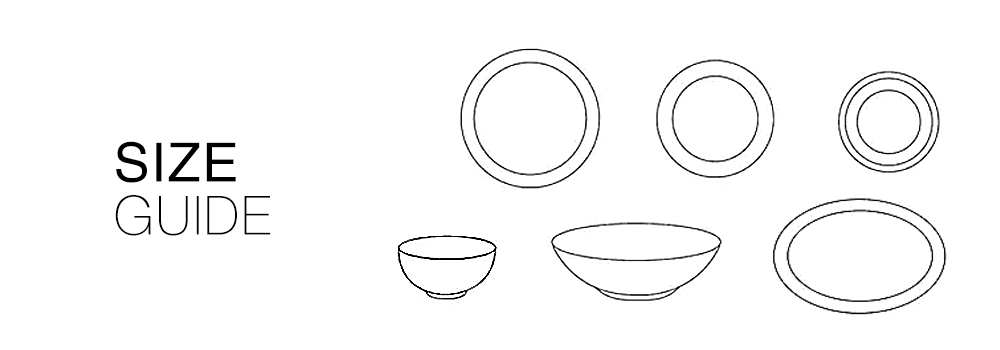
Sizes are given as diameter, and our collection groups every piece into four bands — small (under 12cm), medium (12–18cm), large (19–23cm) and extra large (24cm and above). For drinkware and teapots there is a separate Capacity filter, so you can narrow a search by millilitres rather than width.
The Philosophy Behind the Designs
The traditional Japanese meal follows the principle of ichiju-sansai (一汁三菜) — one soup and three dishes, served alongside rice. Rather than plating everything on one large dinner plate, each dish is given its own small bowl or plate. This is why Japanese tableware is built around many small pieces: a chawan for rice, a kobachi for each side dish, a mamezara for condiments.

It also explains why matching sets are less important in Japan. Pieces of different colours, patterns and regions are freely combined on the same table, so you can build your collection gradually, one piece at a time.
The shapes themselves follow the way Japanese food is eaten. Rice and soup bowls are lifted to the mouth, so a chawan is light, sized to fit the palm, and raised on a small foot — the kōdai (高台) — which keeps your fingers away from the heat of the contents.
One piece rarely has one fixed job. A soba choko holds dipping sauce at lunch and an affogato after dinner; a kobachi works for pickles, salad or dessert. This is worth keeping in mind as you browse — the names describe a size and a shape more than a rule.
The Heart of Craftsmanship: Materials
Most pieces in our collection are ceramic, and Japanese ceramics fall into two broad families, each with a distinct character.
Earthenware (Tsuchimono)
Warm and rustic, earthenware is crafted from natural clay and fired at lower temperatures, giving it a tactile warmth. It is typically glazed to make it suitable for daily use.
Porcelain (Ishimono)
Refined and durable, porcelain is fired at high temperatures, making it waterproof and resistant to odours. It is admired for its elegant, smooth finish.
Every product page lists the material, along with dishwasher, microwave and oven guidance, in its specifications table.
The Significance of Regional Kilns
The origin of a piece, such as Mino Yaki or Hasami Yaki, tells the story of the specific clay and centuries-old traditions of that region. The suffix "yaki" (焼) simply means "ware" or "fired pottery" — so Mino Yaki is pottery fired in the Mino region of Gifu Prefecture.
The easiest way to explore these regions is through the Brand filter, since most makers work within a single pottery centre. For Mino ware, browse Showa Seito, Aito and Miyama. For Kutani ware, browse Kutani, and for Hasami ware, browse Saikai Hasami.
To read more about Japan's pottery regions and what distinguishes them, see our companion guide: Regional Kilns: Crafting the Identity of Japanese Tableware.
Appreciating the Unique Details
Each handcrafted piece shows distinctive details, such as subtle colour variations or uneven surfaces — normal characteristics of traditional craftsmanship rather than faults.
Some pieces may also feature "Kannyu" (貫入), a technique that creates fine, web-like crackles on the glaze. This is intentionally crafted to enhance the visual appeal and uniqueness of each piece. For how the same effect develops on a clay pot with use, see Crazing on a Donabe.
When your order arrives, these small differences are what you will notice first. They are the marks of authenticity that make each item its own.

A Note on Packaging
Packaging varies by product. To see how a specific item is packaged, please refer to its product photos.
- If a box is pictured, your item will arrive in that box. Please note that unless described as a 'gift box', manufacturer packaging is often simple and designed for transit.
- If no box is pictured, the item does not come with its own box. Rest assured, we will pack your order carefully for safe delivery.
About the Author
Authored by Kai, product specialist at My Cookware®. Kai regularly travels to Japan to meet with artisans and personally select the unique, high-quality pieces for our collection.
For any further enquiries, feel free to email us at hello@mycookware.com.au or use the chat box on this page. Our team is committed to a swift response.
See our Japanese Tableware collection.
COPYRIGHT WARNING: Content theft of any kind is immediately reported to Google, which results in ranking penalties. Original texts can be verified in internet archives. My Cookware Australia® holds the copyrights for all the content on this site, including articles, product descriptions, and user guides.


