

Induction Rice Cookers: Luxury or Necessity?
Last updated: 16 September 2026
Induction rice cookers can cost two to three times the price of an ordinary model — enough to give anyone sticker shock. Are they actually worth it? This article explains what induction heating really does, and when the extra spend makes sense.
Our specialist, Kai, wrote this guide to induction rice cookers. In this guide:
- Base heating — how an ordinary rice cooker works, and what it cannot do.
- Induction — what IH changes, and why it costs more.
- The trade-offs — noise, the cooling fan, and what to expect.
- Should you buy one? — pressure, maintenance and the honest answer.
What is base heating in a rice cooker?
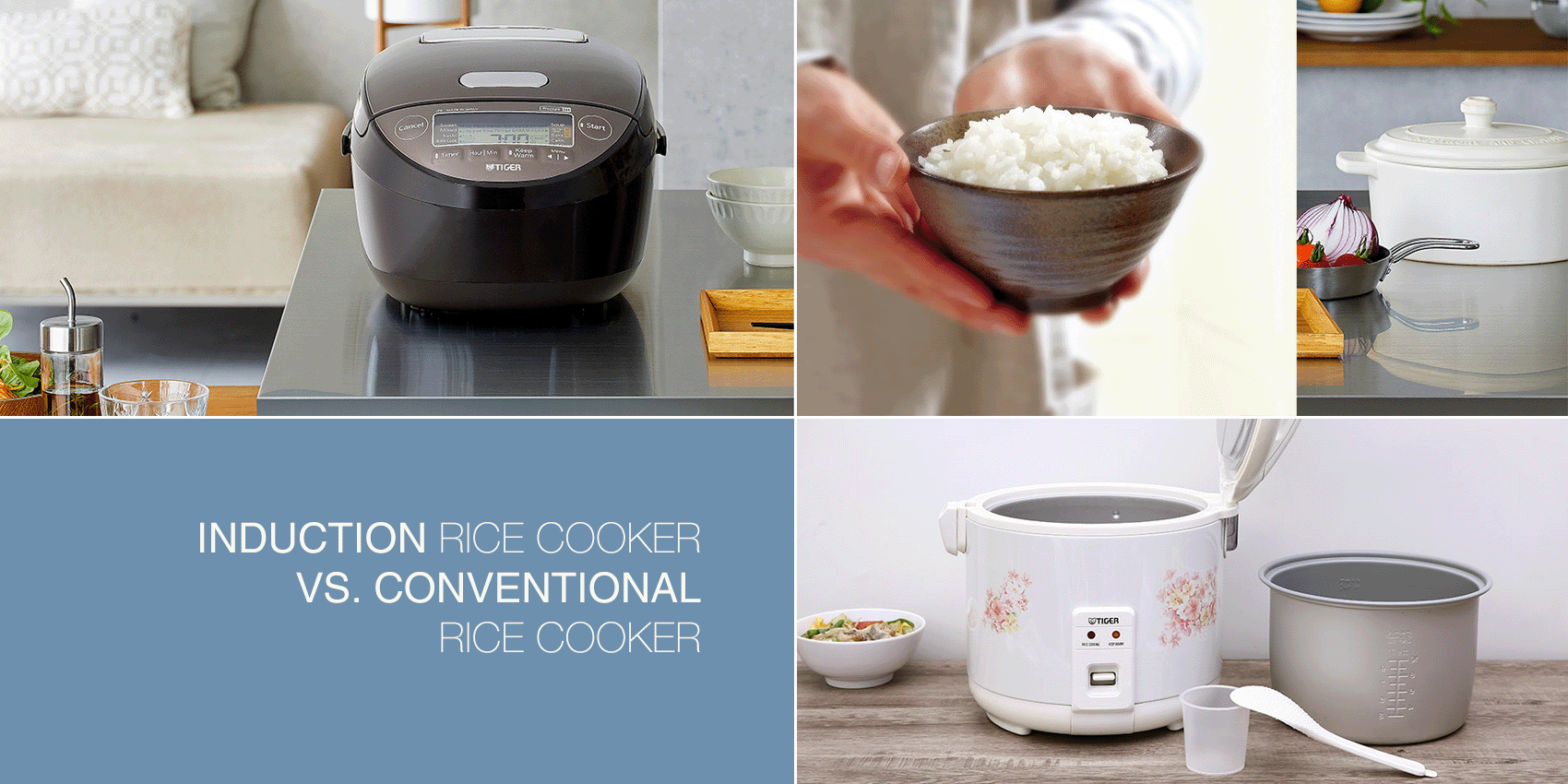
Before looking at induction, it helps to understand the ordinary kind. A conventional rice cooker uses a heating plate at the bottom of the unit. The heat rises through the pot and cooks the rice from below.
Here is how it functions:
- As the rice and water heat up, the water is absorbed by the rice, turning into steam and cooking the grains.
- Once all the water has been absorbed, the temperature inside the pot climbs past 100°C, and the cooker switches to keep-warm mode.
Conventional rice cookers are the most affordable and the fastest we sell — as little as 15 minutes for a small batch. Multifunction models with base heat take 30 to 60 minutes, but still finish ahead of most induction cookers.
The trade-off is that heat is concentrated at the bottom, so cooking is less uniform. The gap between the heating plate and the pot can also catch stray grains, which makes cleaning progressively harder over time — and is a common cause of damage in conventional cookers.
They are also less suited to specialised rice such as GABA brown rice or rice cooked with beans.

What is induction, and why does it cost more?
Induction rice cookers, also called IH rice cookers, have no heating plate at the bottom.
Look at the image above, on the right: there is no heating base. Instead, induction coils surround the inner pot, heating it evenly from all sides rather than only from below.
Does the lid heat up? It depends on the brand
How the lid is handled varies. Tiger's IH models heat the lid as well, while Zojirushi's lid does not generate heat at all — it is designed to absorb and reflect heat back onto the rice. Zojirushi consistently earns the better feedback for rice quality, which suggests a heated lid is not the deciding factor. Buffalo's IH models are simpler again — for pure rice quality they cannot match a top-tier Tiger or Zojirushi, but at their price point they hold up well.
Because the heat comes from all around, an induction cooker handles a wider range of rice dishes than a base-heat model — which matters if you are particular about texture.
Induction cookers are also easier to keep clean, since there is no heating plate underneath to collect burnt-on residue.
One thing to be aware of: induction cookers run a cooling fan, so they are slightly noisier — see the trade-offs below.
What are the trade-offs of an induction rice cooker?
Induction cookers are slightly noisier than base-heat models. The induction coils and their control board generate heat of their own, so the unit has a cooling fan — and you will hear it during cooking and for a while after the cycle finishes. The hum is modest, but in a quiet kitchen it is noticeable, and a conventional cooker makes almost no sound at all.
The fan also runs longer than most people expect. It keeps working after the rice is done to cool the electronics, so a cooker that appears idle may still be running for several minutes. This is normal and not a fault.
Pressure models add their own maintenance — covered in the next section.
Should you buy one?
The question worth asking is whether you need one — and whether the noise and extra cost are worth it to you.
Most induction rice cookers include a pressure function, which raises the cooking temperature. Two things follow from that: the gasket needs replacing every one to two years, and you cannot open the lid mid-cycle to add ingredients.
Pressure also adds to the price. The induction heating itself accounts for most of the gap between an IH model and a base-heat one, and pressure widens it further.
There are induction cookers without pressure, and that is our own preference — the rice quality is there without the maintenance. Our rice cooker comparison sets out why, model by model.
The four types discussed here:
- Conventional rice cookers — mechanical, fastest, no menus.
- Multifunction with base heat — microcomputer control, menus for brown rice and porridge.
- Induction without pressure — even heating, no gasket to replace.
- Induction with pressure — the top tier, best for brown rice.
Other articles that may also interest you:
- Rice Cooker Comparison — Tiger vs Zojirushi vs Cuckoo, model by model.
- Does your rice cooker cook too slowly? — why the better machines take longer.
About the Author
Kai, the author of this article, is our product specialist at My Cookware®. For any questions, email hello@mycookware.com.au or use the chat box on this page.
COPYRIGHT WARNING: Content theft of any kind is immediately reported to Google, which results in ranking penalties. Original texts can be verified in Internet archives. My Cookware Australia® holds the copyrights for all content on this site, including articles, product descriptions, and user guides.


