
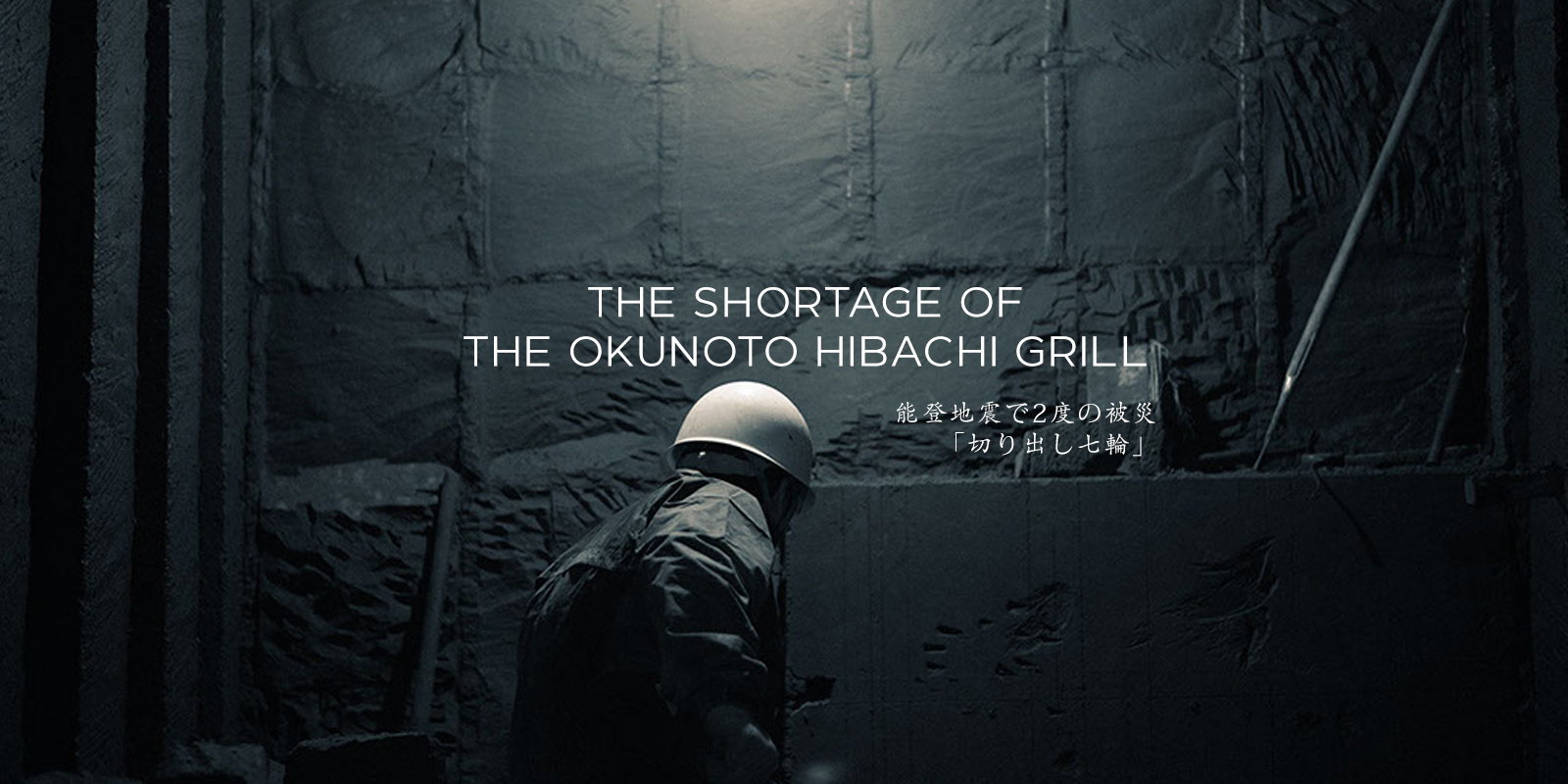
The Shortage of the Okunoto Hibachi Grill
Last updated: 30 August 2026
Once a star on MasterChef Australia and a favourite among home cooks, the Okunoto konro grill spent much of 2024 and 2025 in short supply. Production facilities were restored after the Noto Peninsula earthquake of January 2024, but the raw material behind the grill proved far harder to recover than the factory itself.


Kaori, Kai and Alex put this report together from our own contacts in Japan. In this report:
- Diatomaceous earth — why the raw material, not the factory, became the bottleneck.
- A wider problem — the same ageing-workforce story is playing out across donabe and tableware.
- The earthquake — the scale of the damage across the Noto Peninsula.
- Where things stand in 2026 — production has resumed, but prices are climbing.
Why the diatomaceous earth ran short
When our order was delayed from November to April, then pushed out again to the following August, we knew something was amiss. Japanese manufacturers are known for honouring their commitments, so repeated delays raised immediate concerns. A few phone calls later, we began to piece things together.
Contacts in the Noto production region were mostly hesitant to comment. The few insights we gathered were sobering: “It is too dangerous to collect the material from the mountains,” one person said. Another noted, “Most of the workers are elderly, and they are unwilling to keep going.”
The “material” is diatomaceous earth — listed as diatom mud on our website — cut from the Noto Peninsula. It is what gives the Okunoto grill its insulation and its ability to throw steady radiant heat at the food rather than lose it through the base. Without a reliable supply of it, production cannot keep pace with demand.
The factory itself was restored. Extracting the material was the part that stayed difficult.
We tried to verify the situation with another contact in Tokyo, who distributes diatomaceous earth products and for whom the konro grill is an important part of the business. The shortage made his operations extremely challenging, and in 2024 he decided to design a new konro grill that did not use diatomaceous earth as its primary material. We voiced our apprehension, since the material is central to how the grill performs.


A wider problem in traditional Japanese cookware
The Okunoto konro grill is not the only product affected.
Many traditional Japanese makers, including those producing donabe and tableware, face the same pressures. Since COVID-19 the older generation has been reluctant to continue, and younger people have shown little interest in taking over. We have already seen several donabe models disappear from the market despite steady demand.
Most customers never see this side of the industry, but it is a real and growing problem in Japan's traditional cookware and tableware trades.
How bad was the earthquake?
The January 2024 earthquake, measuring magnitude 7.6, struck at 4:10 pm local time, with Shika recording the maximum seismic intensity of 7. It was followed by fires, landslides, and tsunami waves exceeding 4 metres in some areas. More than 500 lives were lost — a figure that includes disaster-related deaths recorded in the months that followed — and over 115,000 homes were partially or completely destroyed.
The damage extended far beyond residential areas. Roads, rivers, railways, and essential infrastructure were heavily affected, with 93 road sections closed at one point. The ports of Nanao and Wajima were severely damaged, and Noto Airport was shut for weeks. Water outages affecting over 112,000 households added further strain on residents and businesses.
Traditional industries, including makers of konro grills, were hit hard. Government reporting put damage to local industry — much of it small-scale and craft-based — at more than ¥320 billion, leaving many businesses destroyed or struggling to survive. Wajima lacquerware and local salt production reported severe losses of their own.
Where things stand in 2026
Production has resumed. Kinka is making the Okunoto grills again and we are receiving stock, so the acute shortage of 2024 and 2025 has eased. Officially, Kinka never confirmed a suspension of production in the first place.
What has not eased is cost. Quarrying the material is slower and more labour-intensive than it was before the earthquake, the workforce cutting it is ageing with few replacements, and Japan is running through its sharpest period of inflation in decades. Each of those pushes the same way. We expect the price of a genuine Noto diatomaceous earth grill to keep climbing, and the gap between it and every alternative to widen with it.
If that puts the Okunoto out of reach, the Mikawa konro grill is the closest thing to it that we stock: thick moulded diatomite inside a steel case, so you keep the insulating material but in a tougher and more affordable form. Whichever you choose, both are built for binchotan rather than briquettes.
For those interested in the broader impact on the region, the Japanese government has published detailed reports:
Other articles that may also interest you:
About the authors
This report was written by Kaori, Kai and Alex, who look after our contacts in Japan, our buying in Japan, and our marketing in Australia. Email us if you have any questions.
COPYRIGHT WARNING: Content theft of any kind is immediately reported to Google, which results in ranking penalties. Original texts can be verified in internet archives. My Cookware Australia® holds the copyrights for all the content on this site, including articles, product descriptions, and user guides.


